
Metal Seals
Metallic C-seals, with or without spring support, are high-performance sealing solutions used in applications where extreme conditions are the norm.
They offer an exceptional combination of resilience, leak-tightness, and resistance to temperature and pressure, which is why they are widely applied in high-end sectors such as aerospace, oil & gas, and energy (hydrogen, nuclear, turbines, etc.).
C-Seals
Static C-Seals (spring-energised or non-spring-energised)
- Are compressed in the axial direction
- Ideal when limited installation space is available
- Well suited for applications with extremely low leakage requirements
- Require lower bolt loads compared to other metallic sealing solutions
- Impose high requirements on groove dimensions and surface quality
- Resilient: able to compensate for bolt relaxation and flange opening
Within this configuration, two commonly used orientations exist:
- I-C (cavity oriented to the inside):
- The cavity of the C is oriented towards the inner side
- Suitable for internal pressure
- E-C (cavity oriented externally):
- The cavity of the C is oriented towards the outside
- Suitable for external pressure and UHV applications
Compared to elastomeric or composite seals, C-seals maintain their mechanical properties under:
- Cryogenic and very high temperatures
- Ultra-high vacuum (UHV)
- Extremely high pressures
They are capable of compensating for bolt relaxation and/or flange opening without compromising the specified performance requirements.
C-seals are therefore widely used in demanding applications where absolute reliability, extremely low leakage rates and long service life are critical.
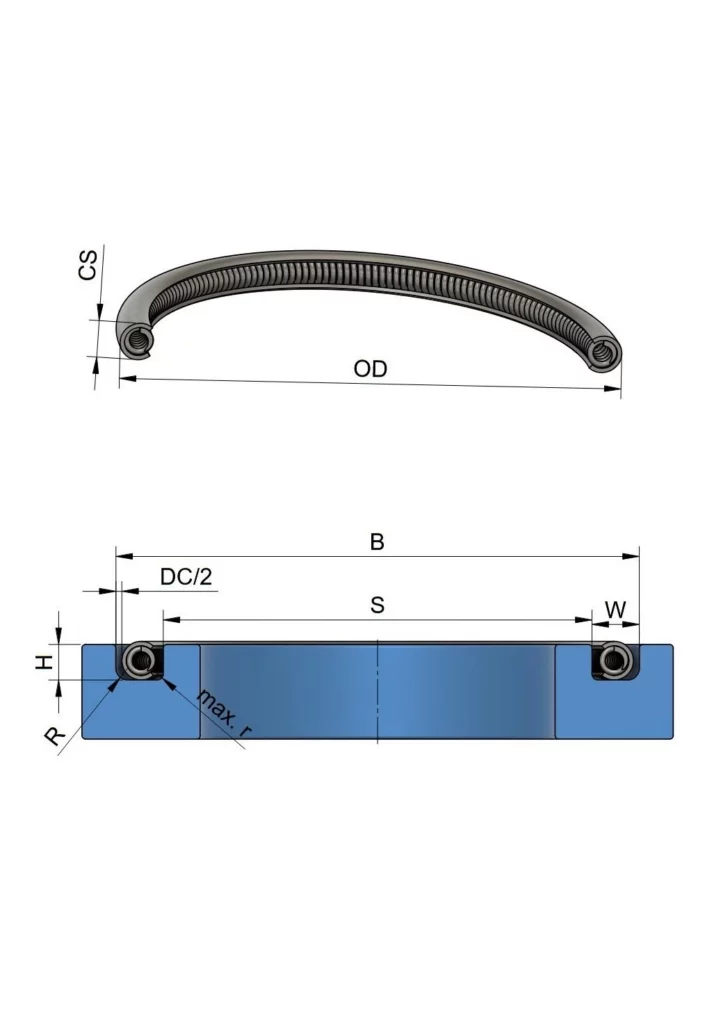
Axiale C- seals A-CN|A-CS
Axial C-seals are metallic sealing solutions that:
- are specifically designed to withstand axial pressure,
- are lightly compressed in the radial direction,
- have their cavity oriented upwards or downwards depending on the pressure direction and the required performance,
- impose high requirements on the surface quality of both the shaft and the housing.
They are used when sealing takes place between two concentric cylinders, with the seal acting on radial contact surfaces. This makes them particularly suitable for a wide range of static and semi-dynamic applications.
Typical applications include:
- Plunger and stem sealing in valves, involving limited linear or rotational movement
- Sealing within cylinder-to-housing assemblies in hydraulic and pneumatic components
- Aerospace actuators, due to their high reliability
- (Cryogenic) temperature-dependent systems where thermal contraction must not affect sealing performance
For bidirectional pressure applications, two axial C-seals can be installed back-to-back. This configuration creates a double sealing line and ensures safe operation in systems where pressure may occur from both directions.

Machined seals
Machined Seals – Fully custom-made for demanding applications
In addition to our metallic C-seals, Provecta offers a wide range of machined seals, such as U-seals, V-seals, K-port seals and other complex profiles that are directly machined from high-performance alloys.
Unlike standardised sealing solutions, machined seals provide maximum design freedom, allowing:
- the profile geometry,
- wall thickness,
- elastic behaviour, and
- contact and sealing surfaces
to be fully optimised based on often challenging application parameters.
These custom-made seals are primarily used in applications involving:
- extreme pressure,
- extreme temperature conditions and fluctuations,
- frequent thermal cycling, and
- very stringent leakage requirements.
By optimising the sealing profile for the specific application, machined seals often achieve even higher reliability than conventional standard solutions.
Machined seals are commonly applied in:
- Subsea equipment, where high pressure, aggressive media and temperature fluctuations are critical factors.
- Aerospace and rocket propulsion systems, where strict tolerance control and thermal stability are essential. (For example, several engines within European launch programmes use custom-designed U- and V-profiles.)
- Cryogenic systems, where material properties vary significantly.
Thanks to the freedom in design, geometry, alloy selection and surface finishing, Provecta delivers solutions that perfectly match the mechanical and thermal requirements of the application.
